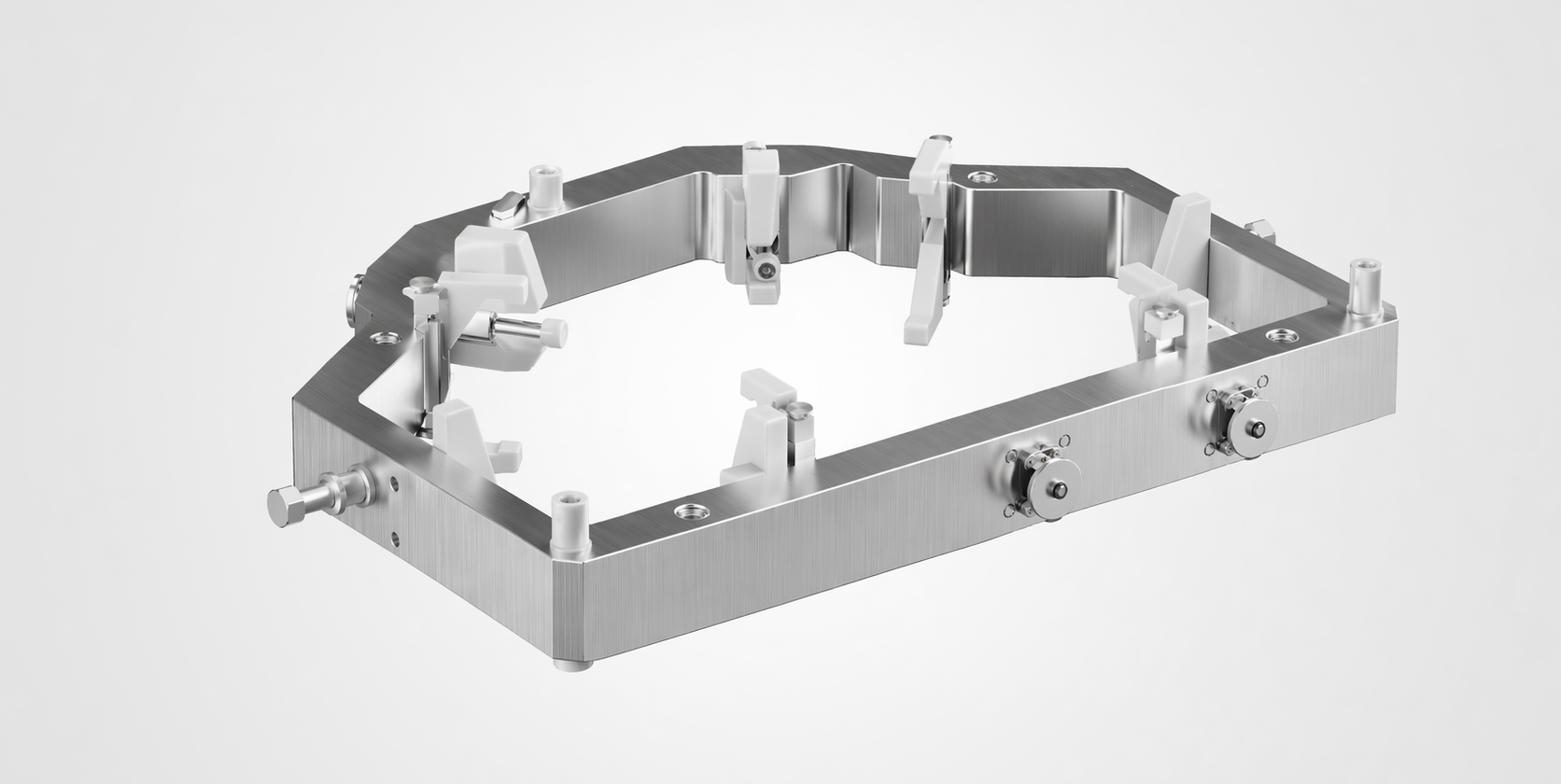
Manufacture of handling equipment
Loading/unloading & handling systems, standard or cleanroom-compatible
Fixture construction of handling devices, systems, loading & unloading tools
In many projects, high-quality, sensitive or cost-intensive products need to be handled safely. Whether manually, with grippers or with special handling devices and systems - especially when weight, dimensions, geometries, ergonomics or assembly situations require it. Fixture construction for handling devices has a name: FRITZ. As standard devices quickly reach their limits, we build special handling devices, handling tools and aids of all kinds: such as handling devices, frames, lifting beams, loading and unloading tools, means of transport or changing stations, for example with quick-change couplings. Customized handling devices facilitate the precise handling of production parts and simplify work steps or internal logistics. We build all types of fixtures, from manual to automatic handling systems - also suitable for cleanrooms.
ADVANTAGES OF OUR HANDLING DEVICES
Time is money: save process steps, production times and costs. Special handling devices from FRITZ ensure that
- The process is precisely matched to the product
- Several process steps are often covered with one handling tool , e.g. transportation, positioning and assembly preparation in one
- Holistic aspects of the periphery are also taken into account
- your products are not damaged or contaminated
- Falling down or out is categorically excluded
- Safety and cleanroom requirements are met
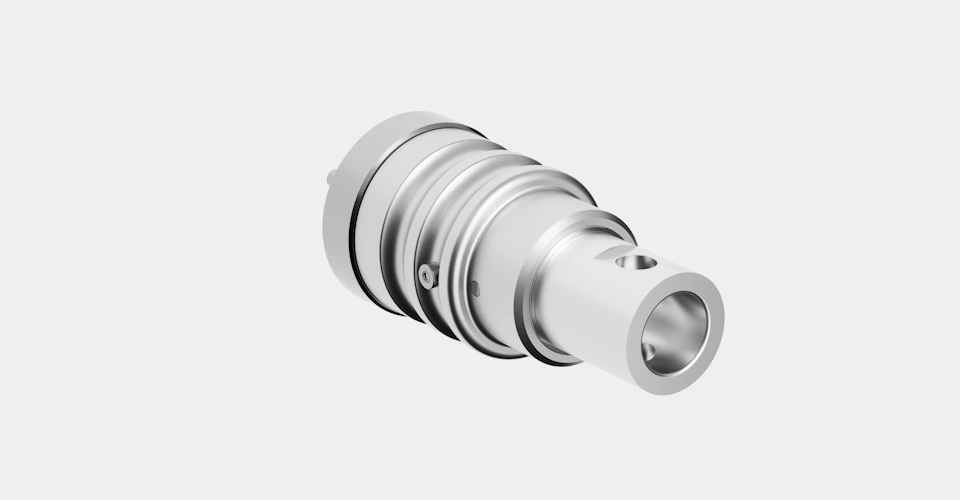
EXAMPLE: (QUICK) CHANGE DEVICES FOR HANDLING & LIFTING OPERATIONS
Time is money. This is why the development of handling systems for fast, simple or short changeover processes plays an important role at FRITZ.
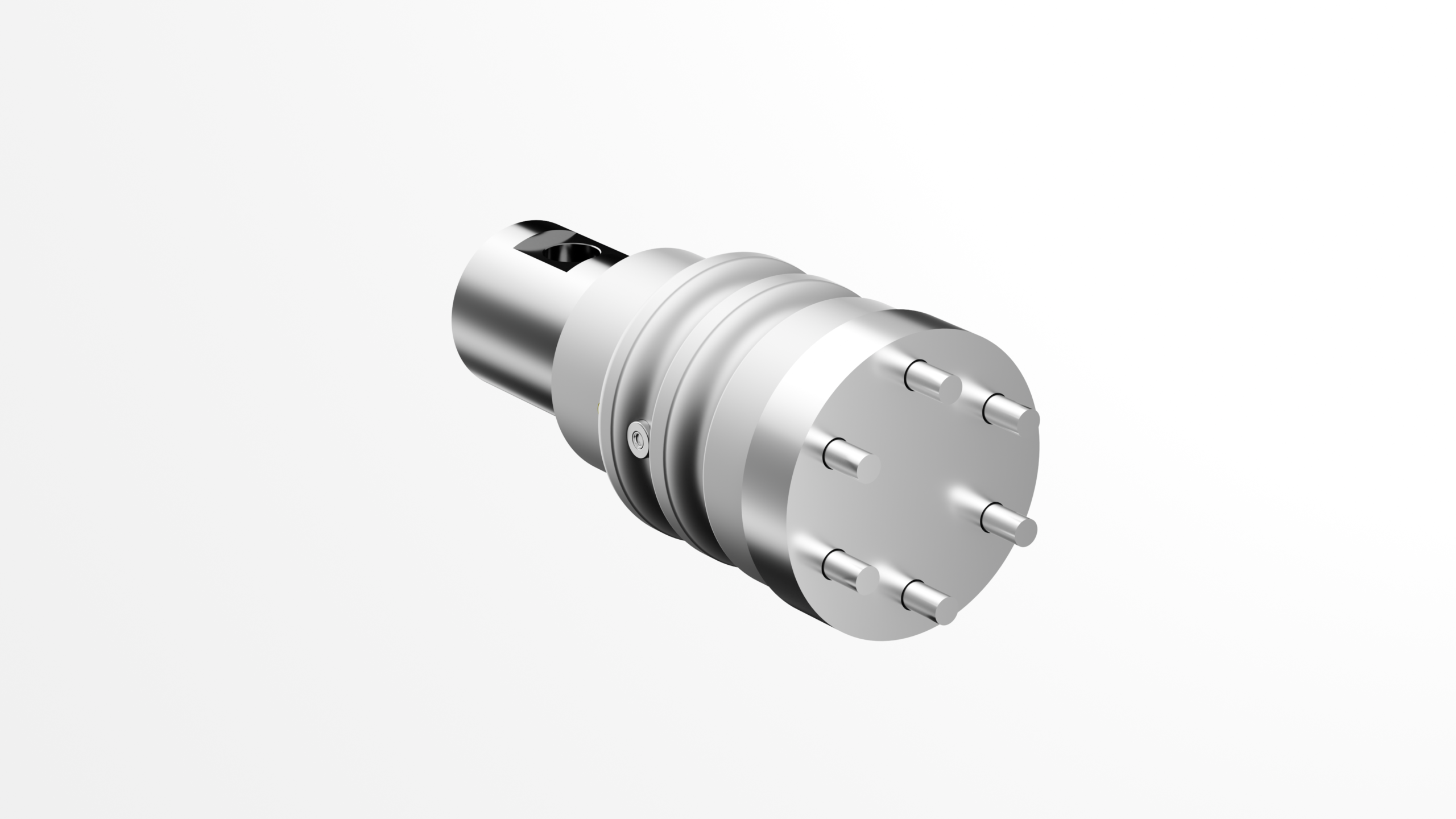
Example here: A cleanroom-compatible quick-release coupling for a load of 120 kg. For quick changes, the holder is quickly attached to the component, the upper part to a lifting device (lifter). A safety mechanism prevents unintentional release - and the quick change is complete!
EXAMPLE: QUICK-CHANGE DEVICES FOR TOOL-FREE HANDLING
Handling devices with quick-release mechanisms, guided movements and self-explanatory locks.
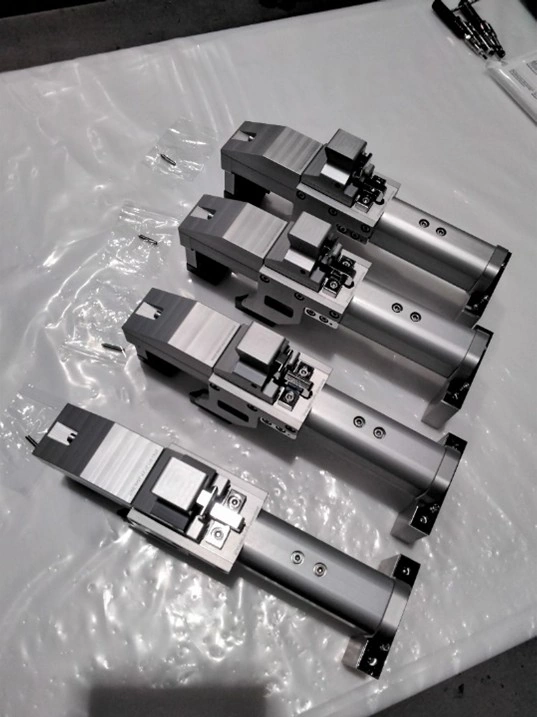
In order to handle parts quickly and safely and make short work of them, ideas for clever, mostly tool-free handling are required. Fritz handling devices offer:
- Fast and intuitive operation
- Reproducible handling, independent of operators
- d. Usually no separate tool in the production or cleanroom area
EXAMPLE: LOADING & UNLOADING DEVICES, ALSO FOR MECHANICAL ENGINEERING
Here is one of many loading and unloading stations. Whether for manual, semi-automatic or fully automatic handling.
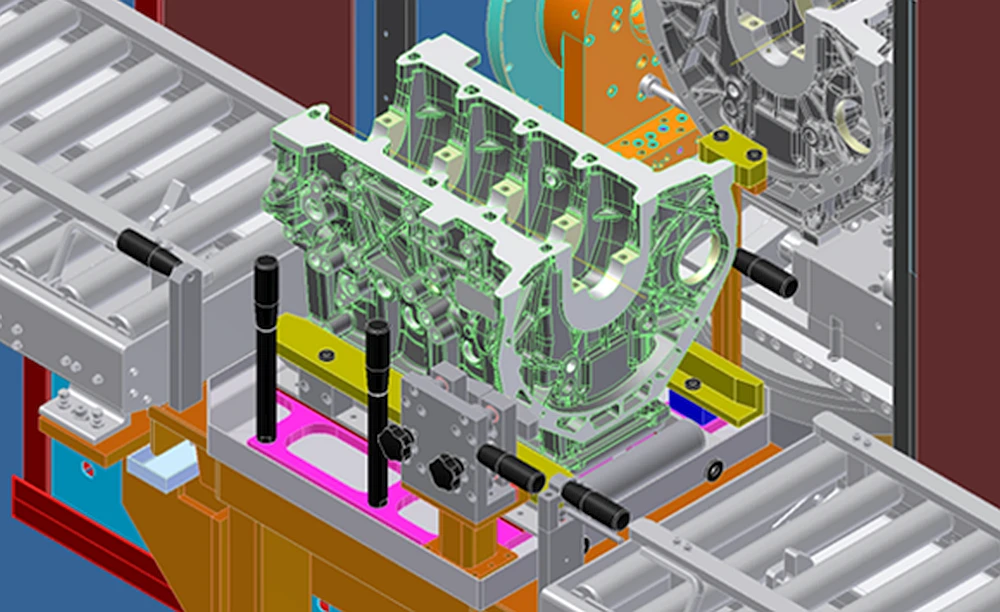
In the area of loading and unloading devices, we cover a broad handling spectrum, from simple manual handling devices and complex handling tooling to semi-automatic or fully automatic handling systems. Shown here is a loading device in the automotive sector that we developed and customized for inline operation. It starts with the layout design, continues with production - and can extend to topics such as control and software ...
FIXTURE CONSTRUCTION HANDLING FIXTURES, FRAMES & DEVICES
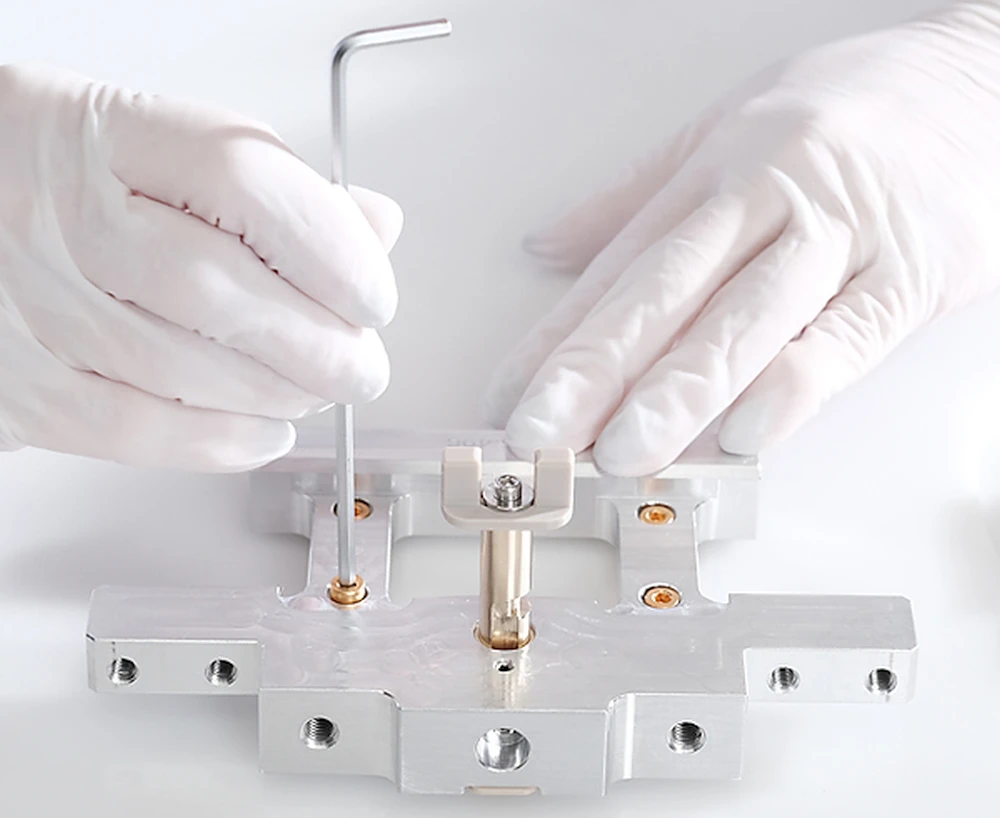
In fixture construction, we design and manufacture handling fixtures and frames in all possible variants. Our cross-process services are also of particular interest to many clients in the clean room.
FAQ Handling devices - what to consider?
Anyone who commissions a handling device from FRITZ ensures that all relevant aspects are observed and fulfilled ...
1. product safety
The product must be secured against falling, slipping out and unintentional release in any position. Securing is form-fit and/or force-fit, depending on the product geometry and process.
2. load handling attachments & safety
Each handling tool is assessed to determine whether it is to be classified as a load handling attachment. If applicable:
- Design in accordance with the relevant directives and standards
- Carrying out the necessary checks
- CE conformity assessment and documentation
Security is not "thought through", but systematically evaluated and safeguarded.
3. cross-process view
Handling tools are not developed in isolation, but in the context of the entire process:
- Inclusion of the product
- Transportation / handover
- Pre-positioning
- Storage in fixtures or at assembly stations
- Editing or testing processes, if applicable
Among other things, the following are considered:
- Directions of movement and degrees of freedom
- Collision risks
- Operator ergonomics
- Transfer points between man, machine and device
The result is a holistic solution, not a single tool.
4. cleanroom suitability
Many handling tools are used in cleanrooms. This results in clear requirements:
- Use of approved materials
- Smooth, easy-to-clean surfaces
- No particle traps or crevices that are difficult to access
- Cleanroom-compatible connecting elements and coatings
The design, choice of materials and production are designed with this in mind from the outset.
5. error avoidance, even with product diversity (Poka Yoke)
In many applications, different products must be handled without confusion. This is implemented, for example, by:
- Product-specific recordings
- Mechanical coding
- geometric exclusion principles (Poka Yoke)
- Clear assignment without software dependency
Incorrect insertion of the wrong product is mechanically prevented.
Our approach:
Holistic development, safe design, cleanroom-compatible construction and cross-process responsibility - from a single source.
6. tool-free handling
Has already been explained. The main aim is to eliminate the need for a separate tool in the production or cleanroom area to ensure quick and intuitive operation.
Typical characteristics:
- Manual handling tools for sensitive individual parts
- Gripper solutions for hoists or manipulators
- Handling devices and systems with multiple functions: Transport, pre-positioning, fixing for assembly or processing
One tool can replace several process steps.
7. target groups & applications
Handling tools of this type are relevant wherever:
- products are of high quality, sensitive or heavy,
- process reliability and product protection are crucial,
- cleanroom or cleanliness requirements apply.
8. typical industries:
- Special machine construction
- Semiconductor & optics industry
- Medical technology
- Precision mechanics
- Assembly and testing technology
Conclusion:
Handling tools are far more than simple aids: safety-relevant equipment, process-defining interfaces between man, machine and product - crucial for quality, ergonomics and efficiency.